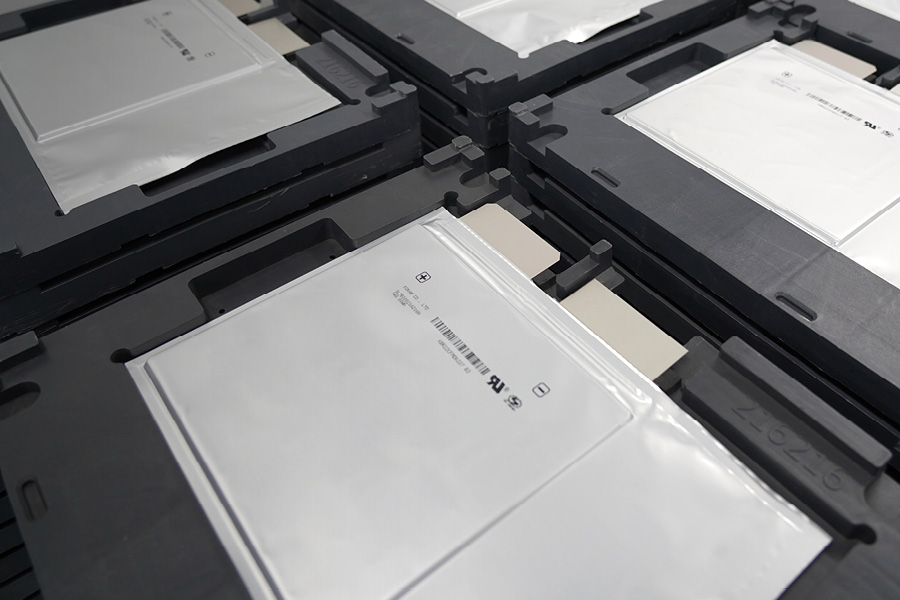

Lithium ion polymer battery technology is based on material
characteristics of lithium - the lightest metal with the
highest electrochemical potential of any solid material.
Currently, there are two different types of lithium ion
rechargeable batteries. The first type, lithium ion batteries
(LIB) use liquid electrolytes with aluminum cans and have
been available from the early 1990's. The second type,
lithium ion polymer batteries (LIPB) use polymer electrolyte
and are recently applying commercial market. The lithium
ion polymer batteries can be packaged in flexible material
and designed to prevent explosion with high internal pressure.
The LIPB and LIB have similar energy densities that are
higher than any other commercially available rechargeable
batteries. Both offer working voltage in the range of
3.0~4.2V compared to 1.2V~1.5V for lead Acid, Ni/Cd, and
Ni/MH rechargeable batteries. Many of R/C mania do not
clearly understand difference between lithium rechargeable
battery characteristics and other batteries. Moreover,
many chargers used in radio control market cannot support
reliable performance depend on lithium rechargeable battery
characteristics. Therefore, we developed Lipo-402 and
Lipo-202 charger as lithium rechargeable battery charger
for R/C mania.
Charge & discharge characteristics of Lithium rechargeable
battery related with charger.
Lithium rechargeable battery use different charging
profile compare to other rechargeable batteries. We
use typical charging profile starting from constant
current charge and converting into constant voltage
charge at 4.2V for these batteries. Since we do not
want to lead side reaction which reduces battery life
and sometimes makes hazardous explosion, we have to
control battery voltage not to over 4.2V/cell during
the charge. Most of chargers in R/C market have not
provided suitable constant current or constant voltage
profiles, since they mainly designed for other battery
systems. They do not support and necessary to use accurate
voltage under controlled condition even though this
is the most important factor for lithium battery charging.
Normally they use a current charge without limitation
or voltage charge while the voltage level maintained
unstable. All of these make serious problems, if these
charger applying for lithium rechargeable batteries.
Kokam Lipo chargers always provide accurate
current and voltage condition with controlled status.
Lipo-402 and Lipo-202 charger consist of main board
with aluminum housing and some electrical parts. Each
parts support reliable function during the charger operation.
Lipo-402 and Lipo-202 used the latest IC and semi-conductor
technologies and designed for DC input condition. They
can successfully handle maximum 4 cells connected in series
by supplying DC power input over 10V. Also they provide
selective control for charging rate and voltage used by
jumper plug.
Some users may think about automatic selection for lithium
rechargeable batteries but it would be
difficult and dangerous. Since we cannot distinguish between
fully charged 3cells in series (12.6V) and fully discharged
4 cells in series (12V) only with their voltage data.
If we charge the 3cells in series with the same end voltage
as 4 cells in series, lithium rechargeable battery will
be damaged. The difference between Lipo-402 and Lipo-202
is input power condition. Lipo-402 charger has boosting
circuitry and powered by any DC source over 10 to 15V
but Lipo-202 does not have this circuitry. Lipo-202 need
higher input voltage than the battery you want to charge.
For example, you should prepare 15V~24V for 11.1V battery
pack charging. The required voltages of the power source
are same as followings.
3.7 - 7.4V CHARGE : INPUT VOLTAGE DC12V~24V
3.7 - 11.1V CHARGE : INPUT VOLTAGE DC15V~24V
3.7 - 14.8V CHARGE : INPUT VOLTAGE DC20~24V
Lipo-402 and Lipo-202 have a lot of strong
point for R/C application
- Stable and accurate voltage control
- Light weight and compact size
- Easy to control and transfer
- Exclusive charging algorithm only for lithium
rechargeable batteries
- High rate charge for higher voltage system
- Protective circuitry for reverse current flow
and short circuit
- Voltage regulative system (Lipo-402)
- You
should make a cable to connect your battery pack
to the charger with supplied
- banana plugs.
1. Prepare 12V (for Lipo-402, 202) and 24V (for
Lipo-202) lead acid
battery or corresponding power supply.
2. Determine charging rate you want
3. Determine pack voltage and capacity
4. Set up the jumper plug corresponding voltage
and current
5. Connect charger to battery pack and power source
6. Monitor charger LEDs
7. Disconnect charger from power source and battery
pack when
the charging is complete.
Item
Voltage
Capacity
Single
cell
3.7V
Depend
on cell capacity(mAh)
Series
connected pack
3.7V
(number of cells in series)
Depend
on cell capacity(mAh)
Parallel
connected pack
3.7V
cell capacity(number
of cells in parallel(mAh))
Series
and parallel
connected pack
3.7V
(number of cells in series)
cell capacity(number
of cells in parallel(mAh))
Most of lithium rechargeable batteries
affected and damaged at a high rate charge or discharge
condition over 1C rate-it would be useful understanding
C rate characteristics to define performance of batteries
and we can use it as a kind of criterion comparing to
each other. C rate defined ratio of current value and
battery capacity when we charge or discharge with the
constant current during 1 hour.
For example
Low rate : 0.2C mA is corresponds to 0.25mA for
1250mAh cell
Moderate : 0.5C mA is corresponds to 0.625mA for
1250mAh cell
High rate : 1C mA is corresponds to 1250mA for 1250mAh
cell